Test whether a listener understands your script
A practical guide to test video script comprehension, with a worked example, clear decision checks, source boundaries and a recording checklist.
 EasyLines team6 min read
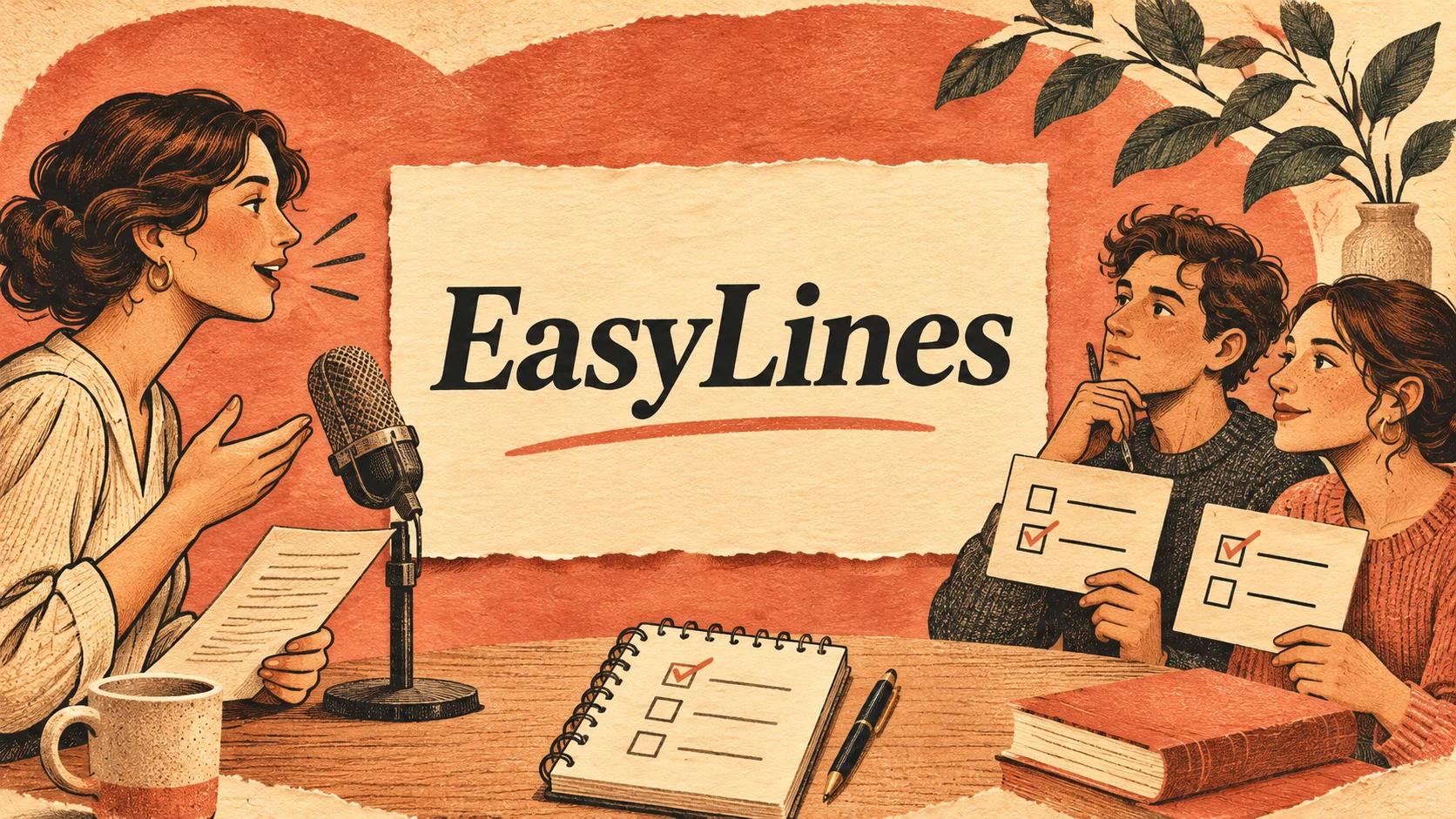
AI-generated editorial illustration.
On this page 8 sections
- 1. What should a listener understand after the video?
- 2. How should you run the first read?
- 3. Which follow-up questions reveal understanding?
- 4. How do you diagnose a misunderstood answer?
- 5. How should you retest a revised script?
- 6. How does this differ from practicing on camera?
- 7. How can you prepare the spoken recording copy?
- 8. Frequently asked questions
Test a video script by asking a listener from the intended audience to explain its main point and next action after one uninterrupted read. Record what they understood before telling them what you meant. Use the gap between the two to revise the explanation, rather than treating a friendly reaction or a smooth performance as proof of comprehension.
What should a listener understand after the video?
Define a small set of expected understandings before you run the test. Include the main answer, an important condition and the action the viewer should be able to take.
For a hypothetical file-export tutorial, those might be where to choose the destination, when to check it and what confirms the export finished. Do not make the test depend on remembering decorative wording or a sentence that has no practical role. Google's audience guidance helps identify the gap between what the audience already knows and what your explanation must add. A knowledgeable colleague may fill in omissions that a beginner cannot. Choose a listener whose starting knowledge resembles the intended viewer, and record any important mismatch. This is a practical editorial test, not a validated learning assessment or a representative research study.
How should you run the first read?
Let the listener hear the script once without interruptions or coaching. Use the delivery format you are evaluating, and make clear whether visuals are included in this test.
If you read the draft aloud without a demonstration, you are testing the spoken explanation, not the whole finished video. If the script deliberately relies on a visual step, include a rough version of that visual or record the limitation of the test. Ask the listener to hold questions until the end so you can distinguish an unclear opening from a point explained later. Avoid explaining a confusing phrase immediately; that changes the material they are assessing. You do not need an elaborate production setup to discover a missing definition. You do need a stable draft and enough separation between the reading and your explanation of what you hoped it would communicate.
Which follow-up questions reveal understanding?
Ask open questions about the meaning and action before asking for general feedback. “What would you do first?” reveals more than “Did that make sense?” because it requires the listener to reconstruct the instruction.
Try four prompts: “What question did this answer?” “What would you do next?” “When would that advice not apply?” and “Which part would you need to hear again?” Use only the prompts relevant to the video's purpose. Do not reward the exact wording you used; a correct explanation in different words can show understanding. Also avoid leading with the intended answer, such as “You understood that the destination comes first, right?” That tests agreement with your correction rather than the original explanation. Write down the listener's response accurately, with their permission if you record it, and keep identifying information out of your working notes unless you need and are authorized to retain it.
How do you diagnose a misunderstood answer?
Compare the response with your expected understandings and locate the earliest missing link. The problem may be an undefined term, a skipped prerequisite, an unclear condition or an action that never became explicit.
Hypothetical test note: “Listener knows to export the file but cannot identify where the destination is chosen.” The useful revision is probably a clearer destination instruction or visual, not a more enthusiastic opening. Another note might be, “Listener thinks the feature is available to every account.” That suggests moving an availability boundary closer to the first feature mention. Use the technical-jargon guide for missing definitions and the short-script pillar for structure. Resist rewriting every sentence based on one person's stylistic preferences. Prioritize misunderstandings that affect the promised answer, and treat broader conclusions about audience behavior as uncertain unless you have appropriate evidence.
How should you retest a revised script?
Retest the changed explanation with a fresh suitable listener when possible. Someone who has already heard your correction may answer from that extra context rather than from the revised script alone.
If you must reuse the same listener, record that limitation and ask them which specific line now supplies the missing information. Do not claim the retest proves a general improvement or a percentage increase in comprehension. Compare concrete outcomes: the listener identified the action, named the condition or still needed a definition. W3C's media planning guidance is useful when the issue concerns whether information is available through the planned media. Captions and descriptions require their own checks; a listener test does not certify accessibility. Keep the scope honest: you are gathering practical evidence about a draft from a small number of people, not measuring the entire audience.
How does this differ from practicing on camera?
Comprehension testing checks what the viewer understands; camera practice checks how you deliver it. Both can matter, but a relaxed read cannot repair a missing instruction or an unsupported claim.
Use the camera practice guide to improve a selected delivery skill after the script communicates the right message. Then use the natural-reading pillar to rehearse the final copy. Save a concise test note: draft version, intended audience, expected understanding, observed gap and revision. Keep personal judgments about the listener out of it. If the same confusion appears again, revisit the explanation's assumptions rather than asking the presenter to emphasize every word. Finish the process when the material supplies the intended answer clearly enough for the task, while preserving any unresolved uncertainty that needs more than a small editorial check.
How can you prepare the spoken recording copy?
Keep the approved words in a separate recording copy and do a short read before the final take. Check the task-specific facts against the sources above, and keep production directions outside the spoken lines. EasyLines is preparing to launch and focuses on reading your script and recording your delivery. If that scope fits your future workflow, join the EasyLines waitlist. Use an available tool for work you need to complete today; the waitlist is not a download or a promised launch date.
Frequently asked questions
Is did that make sense a useful test?
It is weaker than asking the listener to explain the point and next action. Open questions reveal what they understood without supplying your intended answer.
Can I reuse the same listener?
You can, but record that they already heard the explanation. A fresh suitable listener gives a cleaner check of the revised draft.
Does one listener establish audience-wide comprehension?
No. This is a practical editorial check, not a representative study or a validated learning assessment.
Should I test delivery or meaning first?
Check that the script supplies the right answer, then practice delivery. A relaxed read cannot repair a missing condition or instruction.
Sources and further checks
Coming to iPhone and iPad
Put your next script on EasyLines.
A little help with the words. More room to be yourself. Join the waitlist and we’ll email you at launch.