Practice speaking on camera, one skill at a time
Use a short private recording to review one delivery skill, make one specific adjustment, and finish with a clear note for your next practice session.
 EasyLines team7 min read
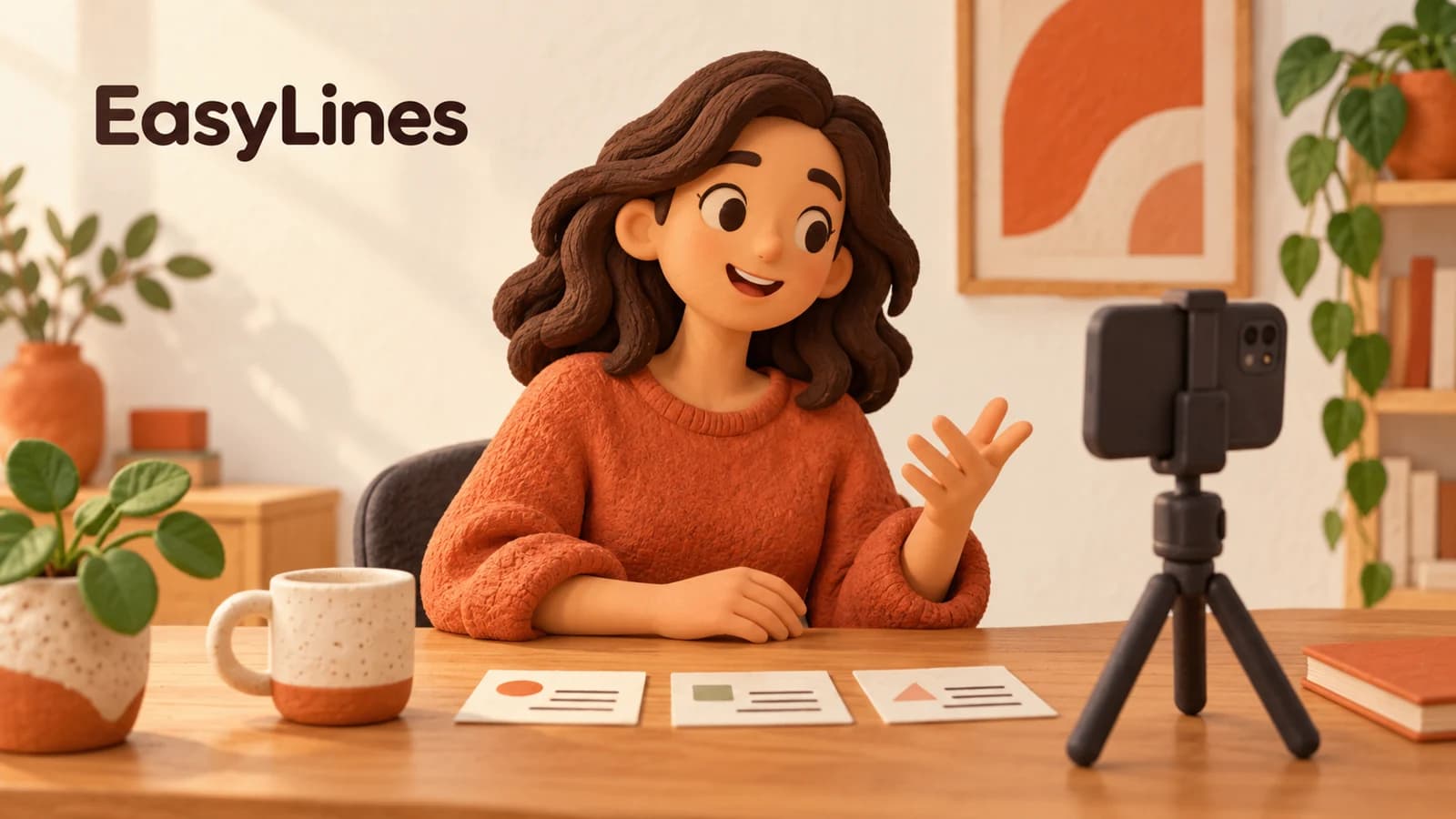
AI-generated editorial illustration.
On this page 7 sections
- 1. Choose a skill you can point to in the recording
- 2. Use a familiar passage with one clear point
- 3. Record one complete baseline without grading it live
- 4. Choose a change that matches the observation
- 5. Try this hypothetical pause exercise
- 6. Try a new passage, then leave a next step
- 7. Frequently asked questions
Practice speaking on camera with one short passage and one observable delivery goal. Record a baseline, review only that goal, make one change, and compare a second take. End by trying the same skill in a different passage. This bounded exercise gives you something specific to learn from the recording without requiring a publishable video.
Choose a skill you can point to in the recording
Write the practice goal before pressing record. “Be better on camera” gives you too many things to judge at once. Choose a visible or audible behavior: leave a pause after the main instruction, finish the last word of each sentence, or keep the object visible while explaining it. Pick the skill that would most help someone follow your particular message.
Add a simple review question. For a pause, ask “Can I hear a break between the instruction and its example?” For an object demonstration, ask “Can I see the relevant part during the action?” These questions turn your review into an observation. They do not require a score for your personality or an opinion about whether you look like an experienced presenter.
The limits in this exercise are practical planning choices, not a scientifically validated training schedule. You can shorten the passage or stop the session whenever it becomes unhelpful. The aim is a useful comparison you can understand, rather than a promise about confidence or a particular number of days until improvement.
Use a familiar passage with one clear point
Choose an ordinary topic you can explain without research: how you organize a drawer, prepare a work bag, or label files. Draft a few sentences with one instruction and an example. Keep the facts familiar so you can spend attention on delivery. Practice is harder to interpret when every pause also reflects uncertainty about what the words mean.
If the passage keeps catching in your mouth, fix it before evaluating delivery. The short-script guide helps you remove written phrasing and focus the point. A difficult sentence and an unfamiliar speaking behavior are separate problems. Make the passage sayable first, then leave it mostly unchanged for the comparison.
Set up the recording once, check that you can hear and see enough for the chosen goal, and keep the arrangement steady. This does not need a polished background or an edited introduction. A practice clip is material for your own review, and you can choose to keep it private.
Record one complete baseline without grading it live
Say the passage through to the end. If you stumble on a word but the point remains understandable, continue. Restarting after every small variation makes it difficult to obtain the sample you need to review. You can correct a factual mistake, then carry on. The first take is a reference for the exercise, not a verdict about your ability.
Toastmasters’ speech preparation guidance recommends recording yourself and reviewing pace and movement. Apply that advice narrowly here: listen for your chosen pause, or watch the chosen action. You can ignore the rest for this pass. If you notice an unrelated issue, place it in a note for another session instead of adding it to today’s task.
Write down the sentence or moment you observed. “The instruction runs straight into the example” gives the next attempt a purpose. “I sound awkward” gives you no clear change to make. Keep one thing that worked in the note as well, such as “the instruction itself is easy to understand.” That helps preserve useful delivery while you adjust one part.
Choose a change that matches the observation
If the instruction and example run together, mark a break between them in your practice text. Say the instruction, allow a comfortable pause, then introduce the example. Keep the wording, camera position, and volume broadly similar. You are trying to hear what that one change does, so this is a poor moment to rewrite the whole passage or invent a new presentation style.
Record a second complete take and review the same question. Compare the matching sentence in both clips. Is there now a break, and does it help you hear the relationship between the instruction and example? If the pause interrupts a connected phrase, move it to the boundary between complete thoughts. A longer pause is not automatically a better pause.
For a gesture goal, follow the same logic. Toastmasters’ guidance on gestures discusses rehearsing intended gestures and using video feedback. Try the meaningful action in the passage rather than adding random movement. Review whether it helps explain the idea and remains visible in your actual frame.
Try this hypothetical pause exercise
Use this invented practice passage: “Put tomorrow’s essentials in one place before you finish work. For example, I would put my notebook, charger, and keys beside the bag. Then I can check the group once before I leave.” This is sample wording for delivery practice, not a claim about a tested organization method or a personal routine.
In the hypothetical baseline, the speaker rushes from “finish work” into “for example.” The practice card says: goal, separate the instruction from the example; observation, no audible break; change, pause after “work.” The second take keeps the rest of the wording. Its review asks only whether the break makes the example easier to identify.
If you were doing the exercise, your actual note might report that the pause helped, that it felt too long on playback, or that you still could not hear a difference. All three are usable observations. Do not prefill a success statement because the exercise suggests an adjustment. The saved clips, and your specific review question, should determine the note.
Try a new passage, then leave a next step
After the comparison, use a different familiar topic with an instruction and example. Try the same pause without copying the original wording. This final attempt asks whether you can use the skill while explaining another idea. It is a small transfer check, not proof that the behavior will appear in every future recording. Keep the passage short enough to review immediately.
End the session with a sentence describing what to repeat next time. “Pause after the complete instruction, then introduce the example” is more useful than “practice more.” If the comparison was unclear, simplify the next task: use a shorter instruction, or review audio alone for an audible goal. You can return to the natural-delivery guide when the difficulty involves reading arrangement rather than the selected speaking skill.
If you want outside feedback, ask one specific question about the chosen moment. Toastmasters also recommends specific feedback questions; a listener can tell you where an example became clear more usefully than rating the entire performance. Do not turn this private drill into an obligation to publish or share the clips. Finish when you have an observation and a sensible next attempt.
- One observable goal written before recording.
- A baseline with a sentence-level observation.
- One adjustment compared in the same passage.
- A different passage and a short note for next time.
Frequently asked questions
How long should my practice video be?
Use a passage short enough to record and review in the time you have. A few complete sentences can be enough for one specific delivery question.
Should I practice with a script or an outline?
Use whichever matches the work you want to record. Keep that choice steady during the two-take comparison so you can focus on the chosen skill.
What if I dislike watching myself?
Start with the smallest useful review: one sentence or an audio-only pass for an audible goal. You decide whether the clip stays private.
Should I count every filler word?
Only if a specific filler habit is your chosen task. For a pause or demonstration exercise, unrelated counting can pull attention away from the review question.
What if the second take is worse?
Keep the observation and reconsider the change. Simplify the passage or move the pause to a complete thought before trying again in another session.
Sources and further checks
Coming to iPhone and iPad
Put your next script on EasyLines.
A little help with the words. More room to be yourself. Join the waitlist and we’ll email you at launch.