Split a long video script into recordable chapters
Divide one long video script into recordable chapters using meaning boundaries, continuity notes and a worked segment map for a single deliverable.
 EasyLines team6 min read

AI-generated editorial illustration.
On this page 7 sections
- 1. Where should a recording chapter begin and end?
- 2. How is this different from a video series?
- 3. What should a chapter map contain?
- 4. What continuity details matter between chapters?
- 5. How should you rehearse and log the parts?
- 6. What should the assembled-video review check?
- 7. Frequently asked questions
Split a long video script into recordable chapters at complete changes of task or idea, then give each chapter a clear opening, ending and continuity note. Keep the chapters connected as one deliverable rather than cutting solely at equal word counts or creating separate episodes the audience does not need.
Where should a recording chapter begin and end?
Begin and end a chapter where the audience can understand a complete thought. A task boundary, a demonstrated result or a change from explanation to practice is usually more useful than an arbitrary number of paragraphs.
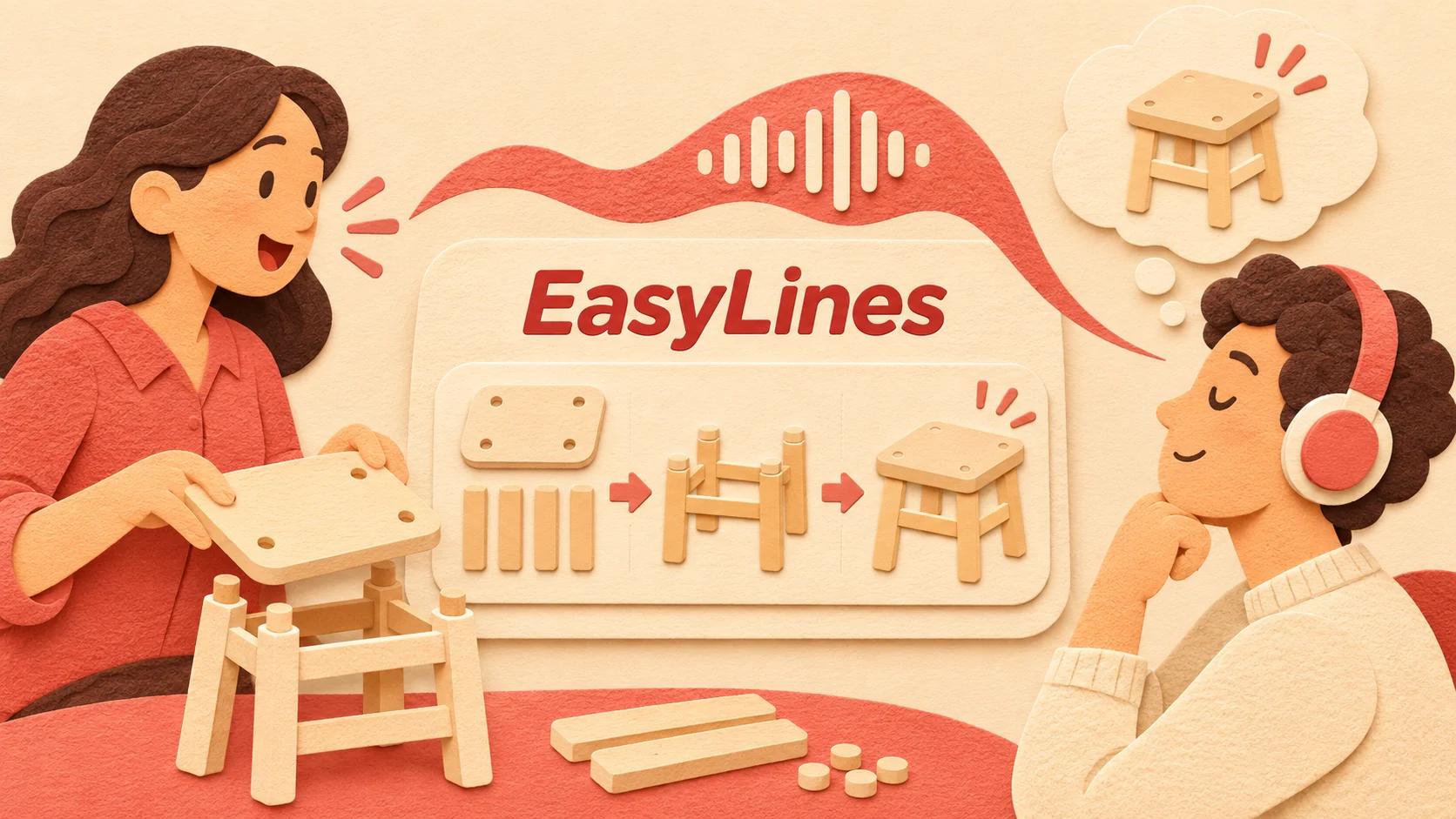
Imagine one long storage-system tutorial. Its recording chapters could be preparing the empty parts, assembling the unit, checking the result and explaining routine use. Each chapter completes a distinct stage of the same lesson. These are hypothetical planning segments, not a claim that every tutorial should use four chapters.
Read the join between chapters aloud. If the next segment begins with “and then that,” it may depend too heavily on wording that will be difficult to match later. Rewrite the opening so it names the relevant state: “With the lid closed, check the latch.” The audience still experiences one continuous lesson, while the recording has a more reliable boundary.
How is this different from a video series?
A chapter split organizes the capture of one intended video. A series divides the audience's learning across separate published pieces, each with its own reason to exist.
Use the video-series planning guide if the audience needs separate lessons. Do not turn a long script into several public videos solely because it is easier to record in parts. The publishing structure should follow the audience's task, while recording boundaries can remain invisible in the final edit.
Write a one-sentence promise for the complete deliverable before splitting. Then place each chapter beneath that promise. If a chapter introduces a new promise that the rest of the video does not support, it may belong in another project. If it simply completes the next stage, keep it connected. This distinction helps avoid repeated introductions, repeated calls to action and recaps that make the final assembled lesson feel like several unrelated recordings.
What should a chapter map contain?
A chapter map should identify the purpose, starting state, ending state, required visuals and preferred take for each segment. Those details let you resume recording without reconstructing the whole session from memory.
For the hypothetical assembly lesson, one entry might say: “Chapter B, attach lid; start with open box and loose lid; end with lid resting in position; close-up of hinge needed.” Another might say: “Chapter C, test latch; begin in the exact position shown at the end of B.”
Keep spoken wording in the script and production state in the map. Mixing every instruction into the teleprompter can make the reading copy harder to use. Give the files matching identifiers so the editor can connect chapter B with its script and inserts. This map is an external planning tool, not an assumed built-in chapter-management feature in any recording app.
What continuity details matter between chapters?
Continuity matters when a visible or spoken state must remain consistent across the join. Check the demonstration object, camera position, props and the facts the speaker refers to.
Take a reference frame before moving anything that must match. Note whether the lid is open or closed, where the hands begin and which part has already been attached. For a pure talking-head explanation, continuity may be simpler, but abrupt changes in framing or object position can still distract from the thought.
Do not chase perfect visual matching when the lesson benefits from an intentional change of view. A wider introduction and a close-up demonstration can join clearly if the script explains the transition. The key is knowing which changes are intentional. If a chapter starts with a different object state and no explanation, the audience may think a step was skipped. Solve the missing meaning before polishing cosmetic consistency.
How should you rehearse and log the parts?
Rehearse each chapter in context, including the final sentence of the previous chapter and the first sentence of the next. This catches broken transitions before you record all the parts.
Record the chapter identifier and take preference in a log. Note deviations that affect later lines, such as using a different example or changing a term. If a later chapter says “the method we just used,” make sure the selected earlier take actually contains that method.
The batch-recording guide helps organize sessions, while this chapter map preserves one video's internal sequence. If you record chapters out of order, inspect the required start state before each take. Do not assume the scene remains correct because the camera has not moved. A prop changed during a later demonstration can quietly make the next earlier chapter impossible to join without another insert or explanation.
What should the assembled-video review check?
Review the complete assembled video for missing steps, duplicated explanations and abrupt references. A chapter can work perfectly alone while the join still fails.
Listen to the full audio in order and ask whether every “this,” “now” and “next” has a clear referent. Then watch the chapter boundaries and confirm the visual state matches the spoken sequence. Remove duplicated housekeeping lines that were useful during recording but do not belong in the final lesson.
Use the natural teleprompter reading guide for the individual performances, then treat assembly as a separate clarity check. EasyLines is preparing to launch around script reading and recording. It is not presented here as an editor or an automatic chapter assembler. Join the EasyLines waitlist for launch information, and keep chapter organization and finishing in a workflow that explicitly supports them.
Frequently asked questions
Should chapters have equal word counts?
No. Use complete ideas or task stages and enough context to join them clearly.
Does splitting a recording mean publishing a series?
No. Recording chapters can form one final video. Separate public lessons need their own audience purpose.
Can I film chapters out of order?
Yes, if you verify each starting state and maintain a clear chapter and take log.
What is the final quality check?
Review the assembled sequence for missing meaning, repeated material and mismatched visual states.
Sources and further checks
Coming to iPhone and iPad
Put your next script on EasyLines.
A little help with the words. More room to be yourself. Join the waitlist and we’ll email you at launch.